Table of Contents
- Overview of Jungle Safari Booking
- What is Online Safari Booking?
- Why Advance Booking is Important for Safari
- Jungle Safari Booking New Updates 2026
- Key Changes in Online Booking System
- New Rules for Safari Entry Permits in 2026
- Updated Safari Booking Process (Step-by-Step)
- Selecting Park, Zone & Safari Type
- Confirmation & Entry Guidelines
- Documents Required for Safari Booking
- Mandatory ID Proof for Booking
- Details Required for Each Visitor
- Safari Timing & Availability (Latest Update)
- Morning vs Evening Safari Timing
- Peak Season Availability Tips
- Common Issues & Booking Mistakes
- Reasons for Booking Rejection
- How to Avoid Booking Errors
- 1. What are the new jungle safari booking rules (2026)?
- 2. Is advance booking mandatory?
- 3. Can I book safari tickets online?
- 4. What documents are required?
- 5. How early should I book?
- 6. Can safari bookings be cancelled?
- 7. What is the best time slot?
- 8. Why do bookings get rejected?
- 9. Is ID proof required at entry?
- 10. Can a travel agency help with booking?
India's national parks and tiger reserves attract millions of wildlife enthusiasts every year. But if you are planning a jungle safari in 2026, you will find that the booking process has evolved significantly. From mandatory online permits to stricter ID verification and zone-based slot management, the system has become more organised — and more competitive. This complete guide walks you through everything you need to know about online jungle safari booking in 2026, including the latest rule changes, step-by-step process, documents required, and expert tips to avoid common mistakes.
Overview of Jungle Safari Booking
What is Online Safari Booking?
Online safari booking is the process of reserving a jungle safari permit through the internet before your visit to a national park or tiger reserve. In India, safari permits are issued by the respective state forest departments and are zone-specific, date-specific, and shift-specific. This means each permit is valid only for a particular entry zone, on a particular date, and for either the morning or afternoon shift.
Platforms like Jungle Safari Bharat allow tourists to browse real-time availability across India's top national parks — including Pench, Kanha, Bandhavgarh, Ranthambore, Jim Corbett, Tadoba, Kaziranga, and more — and book confirmed permits in minutes. Instead of navigating multiple government portals, visitors can manage their entire safari booking, hotel reservation, and naturalist allocation through a single trusted source.
Online booking has effectively replaced the old system of walk-in gate permits in most major reserves, especially in core zones.
Why Advance Booking is Important for Safari
Safari permits are available in limited quantities per zone per shift. For popular parks like Ranthambore, Jim Corbett, and Kanha, demand during peak season (March to June) far exceeds supply. Permits for top zones are often exhausted 60 to 90 days before the safari date.
Advance booking matters for several reasons. It guarantees your entry on your chosen date and in your preferred zone. It allows you to plan travel, accommodation, and naturalist allocation in a coordinated way. It also protects you from last-minute price surges if booking through unofficial channels.
Visitors who arrive at national park gates without a pre-booked permit are routinely turned away, regardless of how far they have travelled. In 2026, with stricter gate verification and digital ID linking, walk-in access is essentially unavailable in most core zones.
Jungle Safari Booking New Updates 2026
Key Changes in Online Booking System
The 2026 safari season has introduced several important upgrades to the online booking system across major Indian national parks:
Unified Portal Progress: Multiple state forest departments have moved toward more integrated booking interfaces. Madhya Pradesh, Rajasthan, and Uttarakhand portals have been updated with better mobile compatibility, faster slot loading, and clearer zone-wise availability displays.
Real-Time Slot Visibility: Visitors can now see the exact number of remaining permits per zone per shift in real time. This helps tourists make quicker and more informed decisions without refreshing repeatedly.
Instant Permit Generation: After successful payment, e-permits are now generated within seconds and delivered via SMS and email simultaneously. The permit includes a unique QR code that is scanned at the forest gate.
Aadhaar-Linked Booking Verification: Bookings at most MP and Rajasthan parks now require the lead visitor's Aadhaar number or Passport number to be entered at the time of booking. This is digitally cross-referenced at the gate and has significantly reduced fraudulent permit transfers.
Cancel and Reschedule Policy Updated: Most parks now allow permit cancellation up to 48 to 72 hours before the safari date for a partial refund. Same-day cancellations are non-refundable. Rescheduling to a different date (subject to availability) is now permitted on most portals — a feature not previously available.
New Rules for Safari Entry Permits in 2026
No Walk-In Entry in Core Zones: Without a pre-booked e-permit, no vehicle is allowed into the core zone of any major tiger reserve. This applies uniformly across Pench, Kanha, Bandhavgarh, Ranthambore, and Corbett.
Mandatory Naturalist for All Core Zone Safaris: A certified Forest Department naturalist must accompany every Gypsy in the core zone. Independent entry without a naturalist is no longer permitted. Naturalists must also be pre-booked along with the permit in most parks.
Vehicle Capacity Strictly Enforced: A Gypsy carries a maximum of 6 passengers plus 1 naturalist plus 1 driver. No exceptions are made at the gate. Extra passengers are turned away even if they hold a valid permit.
Permit Transferability Banned: Safari permits are non-transferable. The person whose ID is linked to the permit must be present at the gate. You cannot give your permit to someone else.
Photography and Equipment Restrictions: DSLR cameras and video equipment are allowed but require a separate camera fee. Drones are completely banned inside all national parks. Flash photography near wildlife is a punishable offence.
Updated Safari Booking Process (Step-by-Step)
Selecting Park, Zone & Safari Type
Booking a jungle safari online in 2026 follows a clear process. Here is how it works step by step.
Step 1 – Choose Your National Park Decide which park you want to visit based on your travel dates, location, and wildlife interest. If tiger sightings are your priority, Ranthambore (June for waterholes), Bandhavgarh (high tiger density), or Kanha (meadow sightings) are excellent choices. For elephants and one-horned rhinos, Kaziranga in Assam is unmatched.
Step 2 – Select Your Safari Zone Every national park is divided into zones. Core zones have higher wildlife activity but limited permits and higher fees. Buffer zones are less crowded, often more scenic, and good for birding and leopard sightings. Research the zones for your chosen park before selecting.
Step 3 – Pick Date and Shift Most parks offer a Morning Shift (sunrise to late morning) and an Afternoon Shift (early afternoon to sunset). Morning safaris generally offer better tiger sighting chances as animals are more active at dawn. Select both the date and shift carefully — you cannot change these after booking without cancellation.
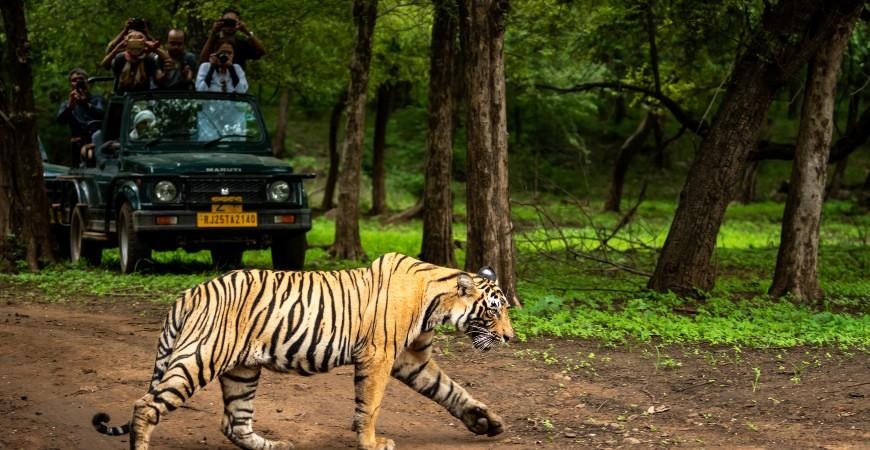
Step 4 – Select Safari Vehicle Type Gypsy (open jeep, 6 seats): Recommended for a flexible, intimate wildlife experience. Can access narrow forest tracks. Ideal for photography and small groups. Canter (open bus, 16 to 20 seats): Available in some parks like Ranthambore and Corbett. More affordable but less manoeuvrable. Better for large groups or budget-conscious travellers.
Step 5 – Enter Visitor Details Submit full name, age, nationality, and ID proof number (Aadhaar/Passport/Voter ID) for each visitor. All details must exactly match the original ID that will be presented at the gate. Double-check everything before proceeding to payment.
Step 6 – Pay and Download E-Permit Pay using UPI, net banking, or credit/debit card. Your e-permit is generated immediately after successful payment. Download it, save a screenshot, and also note the booking reference number separately.
Confirmation & Entry Guidelines
After completing the booking, follow these steps on the day of your safari.
Arrive at the correct forest gate 25 to 30 minutes before your assigned safari start time. Each zone has a specific entry gate — confirm this before leaving your hotel. Carry the original ID proof used during booking (photocopies are not accepted). Present your e-permit either digitally on your mobile screen or as a printed copy. The QR code will be scanned by the forest officer at the gate.
Your assigned naturalist and Gypsy driver will be present at the gate. Board the vehicle, follow all safety briefings given by the naturalist, and switch your mobile to silent mode before entering the forest.
Documents Required for Safari Booking
Mandatory ID Proof for Booking
Every visitor must provide a valid, government-issued photo ID at the time of online booking. Accepted documents include Aadhaar Card, Voter ID Card, Passport, and Driving Licence. The ID number entered during booking is verified at the gate, so it must be the same document you carry on the day.
For foreign nationals, a valid Passport is the only accepted identification. Foreign visitors are also charged at a higher permit rate (International Visitor tariff) and may need to fill a separate registration form at the park reception before their first safari.
Details Required for Each Visitor
At the time of booking, the following details must be submitted for every person in the safari group — not just the lead visitor:
-
Full name (as printed on ID proof)
-
Age
-
Gender
-
ID proof type and number
-
Nationality
-
Contact mobile number (at least for the lead visitor)
For groups with children, age proof may be required at the gate for children claimed to be below 5 years (who may be exempt from permit fees or vehicle count rules).
Safari Timing & Availability (Latest Update)
Morning vs Evening Safari Timing
Safari timings vary by season and park. The general schedule for 2026 is as follows:
Morning Safari — Summer Season (March to June) Most parks: 5:30 AM to 10:00 AM This is the prime slot for tiger sightings. As temperatures rise rapidly after 10 AM, animals retire to shade and become harder to spot.
Morning Safari — Winter Season (October to February) Most parks: 6:30 AM to 10:30 AM Mornings are cooler and fog may be present in November and December. Visibility improves as the sun rises.
Afternoon Safari — Summer Season Most parks: 2:30 PM to 6:30 PM Late afternoon heat begins to ease and animals start moving toward waterholes again. Good for sightings near water.
Afternoon Safari — Winter Season Most parks: 2:00 PM to 5:30 PM Shorter afternoon window due to early sunset. Good for birding and movement near forest edges.
Morning safaris are generally preferred for tiger sightings. Afternoon safaris are often more available and sometimes more peaceful due to lower visitor numbers.
Peak Season Availability Tips
March to June is the most competitive period for safari permit availability at all major parks. Follow these strategies to secure permits during peak season.
Start monitoring availability 90 to 120 days in advance for top zones (Dhikala at Corbett, Turia at Pench, Zones 2 to 4 at Ranthambore, Khatia at Kanha). Set a reminder and check the portal early in the morning — new slots often get released or become available due to cancellations. Book through Jungle Safari Bharat to receive real-time availability updates and expert booking support. If your first choice zone is unavailable, ask for alternative zone recommendations — experienced naturalists know which buffer zones are currently productive for tiger activity.
For the winter season (October to February), booking 30 to 45 days in advance is usually sufficient, except during school holidays (Christmas to New Year week) when demand spikes sharply.
Common Issues & Booking Mistakes
Reasons for Booking Rejection
Even after a successful online booking, entry can be denied at the forest gate due to the following reasons:
ID Mismatch: The most common problem. Even a small spelling difference — for example, "Rahul" in the booking vs "Rahull" on the Aadhaar card — results in rejection. Always copy the name exactly as it appears on the ID.
Wrong Gate Reporting: Each zone has a specific entry gate. Arriving at the wrong gate is a very common and costly mistake, especially at parks with multiple gates like Kanha (four gates) and Jim Corbett (five zones). Confirm your gate location the night before.
Late Arrival: Gates open exactly at the scheduled safari time. Arriving even 10 minutes late means forfeiture of the permit with no refund. There are no exceptions.
Expired or Unreadable QR Code: If your e-permit QR code is a low-resolution screenshot or the link has expired, the gate scanner cannot verify it. Always download the permit as a high-resolution PDF or image immediately after booking.
Overcrowded Vehicle: Attempting to board more passengers than declared in the permit is a ground for immediate denial. Each additional person requires a separate permit.
Missing Naturalist Booking: At parks where naturalist pre-booking is mandatory, arriving without a confirmed naturalist assignment may prevent entry into the core zone.
How to Avoid Booking Errors
Cross-check every visitor's name and ID number before confirming your booking. Save the e-permit in at least two locations (phone gallery and email). Confirm your gate name and its Google Maps location the evening before your safari. Arrive 30 minutes early. Call your hotel or the booking agency the night before to reconfirm all details.
Booking through a trusted platform like Jungle Safari Bharat means you have expert support available — if any issue arises, the team can assist with corrections, alternative bookings, or escalation with the forest department helpline.
1. What are the new jungle safari booking rules (2026)?
-
Mostly online permit system is compulsory
-
Strict ID verification
-
Limited bookings per ID
-
Seats/zones on first-come, first-served basis
2. Is advance booking mandatory?
-
Not strictly mandatory
-
But highly recommended (slots fill quickly)
3. Can I book safari tickets online?
-
Yes, online booking is available via official websites
4. What documents are required?
-
Valid government photo ID (Aadhar, Passport, Driving License, etc.)
-
Foreign tourists need a Passport
5. How early should I book?
-
Booking opens 30–120 days in advance
-
Best to book 1–2 months earlier
6. Can safari bookings be cancelled?
-
Usually non-refundable / non-cancellable after confirmation
7. What is the best time slot?
-
Morning safari is best (higher chances of wildlife sightings)
8. Why do bookings get rejected?
-
No availability
-
Incorrect details / ID mismatch
-
Multiple bookings with same ID
9. Is ID proof required at entry?
-
Yes, you must carry the same original ID used during booking
10. Can a travel agency help with booking?
-
Yes, agencies can assist
-
But final booking depends on forest department availability
Recent Posts

Book Your Wildlife Safari
Experience the thrill of the jungle. Book your customized Safari packages and hotels with us.
Enquire Now